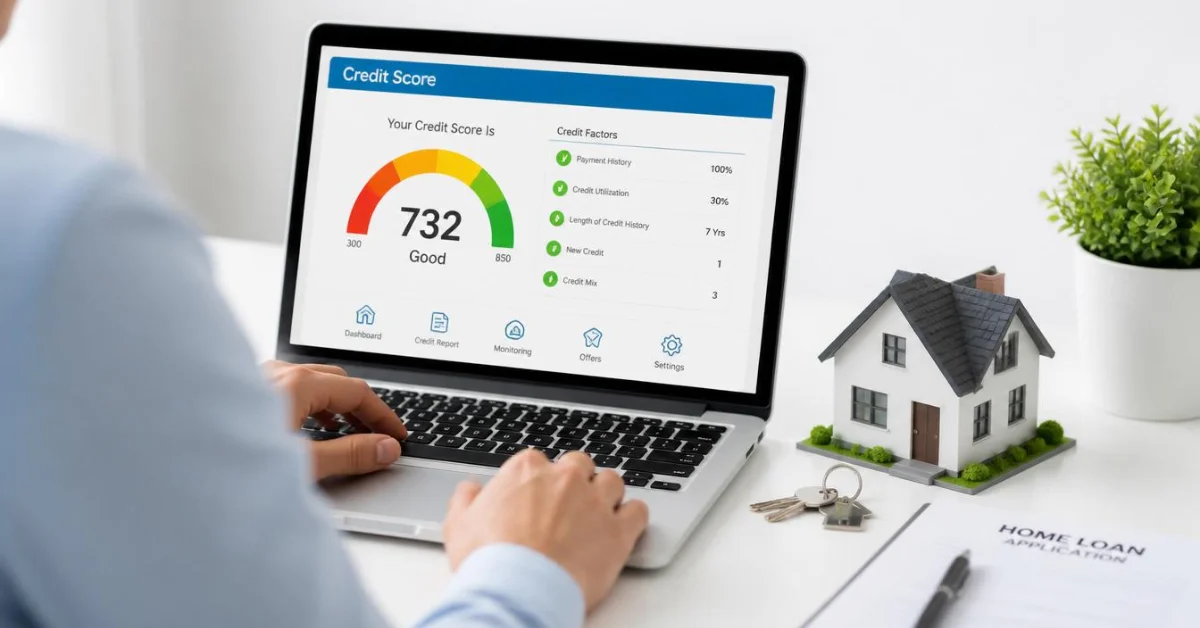
Want to know how to fix credit to buy a house? Your credit score is the single most important number in the homebuying process — it determines whether you qualify for a mortgage, what interest rate you get, and how much you pay over the life of your loan. The good news is that fixing your credit to buy a house is absolutely achievable, even if your score is low right now. This step-by-step guide shows you exactly how to fix your credit to buy a house, with real numbers, timelines, and US-specific resources.
Why Your Credit Score Matters So Much for Buying a House
Before fixing your credit, understand what is at stake. Here is what your credit score means for your mortgage in real dollar terms:
| Credit Score | Loan Type Available | Typical Interest Rate (2026) | Monthly Payment on $300K Loan |
|---|---|---|---|
| 760–850 (Excellent) | Conventional | ~6.5% | ~$1,896 |
| 700–759 (Good) | Conventional | ~6.8% | ~$1,953 |
| 650–699 (Fair) | Conventional/FHA | ~7.2% | ~$2,039 |
| 620–649 (Poor) | FHA only | ~7.8% | ~$2,154 |
| 580–619 (Bad) | FHA with 10% down | ~8.5% | ~$2,307 |
| Below 580 | Very difficult to qualify | N/A | N/A |
The difference between a 620 and a 760 credit score on a $300,000 mortgage is over $250 per month — that is $90,000+ over a 30-year loan. Fixing your credit before buying a house is one of the highest-return financial moves you can make.
What Credit Score Do You Need to Buy a House in the US?
- Conventional loan: Minimum 620 (most lenders prefer 680+)
- FHA loan: Minimum 580 with 3.5% down payment, or 500 with 10% down
- VA loan (veterans): No official minimum, but most lenders require 620+
- USDA loan (rural areas): Minimum 640
- Jumbo loan (over $766,550): Minimum 700–720
Target score: Aim for 740 or higher to get the best mortgage rates available. Once your credit is ready, you may also want to start saving for your down payment. Even going from 680 to 740 can save you $50–$100/month on your mortgage payment.
Step 1: Get Your Free Credit Reports
The first step to fixing your credit is knowing exactly where you stand. You are entitled to one free credit report per year from each of the three major US credit bureaus — Equifax, Experian, and TransUnion.
How to get your free reports:
- Go to AnnualCreditReport.com — the only official free credit report site authorized by the US federal government
- Request all three reports at once (Equifax, Experian, TransUnion)
- Download and save each report as a PDF
Also check your credit score for free:
- Credit Karma — Free TransUnion and Equifax scores updated weekly
- Experian — Free Experian score at experian.com
- Your bank or credit card — Most major US banks (Chase, Bank of America, Wells Fargo, Capital One) provide free credit score monitoring
Pro Tip: Check all three bureaus separately — your score can vary by 20–50 points between bureaus, and mortgage lenders typically use your middle score from all three.
Step 2: Dispute Errors on Your Credit Report
This is the fastest way to improve your credit score — and it is completely free. According to the Federal Trade Commission, approximately 1 in 5 Americans has an error on their credit report. Common errors include:
- Accounts that do not belong to you (identity theft or mixed files)
- Late payments reported incorrectly
- Accounts showing as open that you closed
- Duplicate accounts listed twice
- Wrong balances or credit limits
- Negative items older than 7 years (10 years for bankruptcy)
How to Dispute Errors:
- Identify the error on your report
- Gather documentation proving the error (bank statements, letters, etc.)
- File a dispute online at each bureau’s website:
- Equifax: equifax.com/personal/credit-report-services
- Experian: experian.com/disputes
- TransUnion: transunion.com/credit-disputes
- The bureau has 30 days to investigate and respond
- If the error is confirmed, it must be removed or corrected
Timeline: Disputed errors can be removed in 30–45 days, potentially boosting your score by 20–100+ points depending on the severity of the error.
Step 3: Pay Down Credit Card Debt (Lower Your Utilization)
Credit utilization — how much of your available credit you are using — makes up 30% of your FICO score. It is the second most important factor after payment history.
The rule: Keep your credit utilization below 30% on each card and overall. Below 10% is ideal for maximum score improvement.
| Credit Limit | Current Balance | Utilization | Impact on Score |
|---|---|---|---|
| $10,000 | $8,000 | 80% — Very Bad | Major negative impact |
| $10,000 | $3,000 | 30% — Acceptable | Neutral |
| $10,000 | $1,000 | 10% — Excellent | Major positive impact |
| $10,000 | $0 | 0% — Perfect | Best possible |
Strategy: Pay down the card closest to its limit first (highest utilization), then move to the next. Even paying one card from 90% to 30% utilization can add 50–100 points to your score.
Pro Tip: Ask your credit card company to increase your credit limit — this immediately lowers your utilization ratio without paying a dollar. Call the number on the back of your card and ask for a credit limit increase. Most issuers will approve this if you have been a customer for 12+ months with on-time payments.
Step 4: Never Miss a Payment — Ever
Payment history is the single most important factor in your credit score — it makes up 35% of your FICO score. One missed payment can drop your score by 60–110 points and stays on your report for 7 years.
How to ensure you never miss a payment:
- Set up autopay — Set at least the minimum payment on autopay for every account. Do this today — it takes 5 minutes per account
- Use calendar reminders — Set a reminder 5 days before each due date
- Consolidate payment dates — Call your credit card companies and ask to move all due dates to the same day each month — most will accommodate this
If you have missed payments: The impact lessens over time. A missed payment from 2 years ago hurts far less than one from 2 months ago. Keep paying on time consistently and the damage will fade.
Step 5: Do Not Close Old Credit Cards
Many people think closing old credit cards helps their credit — it actually hurts it. Here is why:
- Credit age matters — Length of credit history makes up 15% of your score. Closing old cards shortens your average account age
- Available credit decreases — Closing a card reduces your total available credit, which raises your utilization ratio
What to do instead: Keep old cards open and use them for one small purchase per month (like a Netflix subscription or gas fill-up). Pay the balance in full each month.
Step 6: Do Not Apply for New Credit Before Buying a House
Every time you apply for new credit — a credit card, car loan, store card — it creates a hard inquiry on your credit report, which temporarily lowers your score by 5–10 points. Hard inquiries stay on your report for 2 years.
The rule: Stop applying for any new credit at least 6–12 months before applying for a mortgage. Do not open new credit cards, finance a car, or sign up for store credit offers during this period.
Exception: When shopping for a mortgage, multiple mortgage inquiries within a 14–45 day window count as a single inquiry. So feel free to get quotes from multiple lenders — just do it all within the same month.
Step 7: Consider Becoming an Authorized User
If a family member or close friend has excellent credit, ask them to add you as an authorized user on their credit card. Their positive payment history and low utilization on that card will appear on your credit report — potentially boosting your score by 20–50 points within 1–2 months.
You do not even need to use the card — just being listed as an authorized user is enough for the credit benefit.
How Long Does It Take to Fix Credit to Buy a House?
| Starting Score | Target Score | Realistic Timeline | Key Actions |
|---|---|---|---|
| 580–620 | 680+ | 6–12 months | Dispute errors, pay down debt, no missed payments |
| 620–660 | 700+ | 3–6 months | Lower utilization, autopay everything |
| 660–700 | 740+ | 3–6 months | Lower utilization below 10%, dispute any errors |
| 700–720 | 760+ | 2–4 months | Fine-tune utilization, authorized user strategy |
US Government Programs That Help First-Time Homebuyers with Low Credit
Even while working on your credit, explore these US programs designed for buyers with lower scores:
- FHA Loans — Federal Housing Administration loans require only 580 credit score with 3.5% down payment. Available through most US banks and mortgage lenders
- VA Loans — For US military veterans and active duty — no minimum credit score requirement from VA, no down payment required
- USDA Loans — For rural and suburban homebuyers — low rates, no down payment, requires 640+ score
- State First-Time Homebuyer Programs — Most US states have programs with down payment assistance and favorable rates. Search “[your state] first time homebuyer program” to find what is available
- HUD Housing Counseling — Free homebuying counseling at HUD.gov — a HUD-approved counselor can review your credit and create a personalized plan
Frequently Asked Questions
How long does it take to fix credit to buy a house?
Most people see meaningful improvement in 3–6 months with consistent effort. Going from a 580 to a 680 score typically takes 6–12 months. The fastest improvements come from disputing errors (30–45 days) and paying down credit card balances (1–2 billing cycles to reflect on your report).
What is the minimum credit score to buy a house in the US?
The minimum depends on the loan type. FHA loans allow scores as low as 500 (with 10% down) or 580 (with 3.5% down). Conventional loans typically require 620+. For the best interest rates, aim for 740+. VA loans have no official minimum from the VA, though most lenders require 620+.
How much does fixing credit save on a mortgage?
Improving your credit score from 620 to 760 on a $300,000 mortgage can save you $200–$300 per month in interest — that is $72,000–$108,000 over a 30-year loan. Even a 40-point improvement from 680 to 720 can save $50–$100/month.
Can I buy a house with a 600 credit score?
Yes — through an FHA loan. With a 600 score, you can qualify for an FHA loan with a 3.5% down payment. However, your interest rate will be higher than someone with a 700+ score, meaning you will pay more over the life of the loan. It is worth spending 6 months improving your score before applying if possible.
Does paying off collections help credit score for buying a house?
It depends. Paying off recent collections (under 2 years old) can help significantly. Older collections have less impact on newer FICO scoring models. However, many mortgage lenders require all collections to be paid before approving a loan, regardless of score impact. Check with your specific lender about their requirements.
Start Fixing Your Credit Today
Now you know exactly how to fix your credit to buy a house. Start with the steps that have the fastest impact — get your free credit reports from AnnualCreditReport.com, dispute any errors, and set up autopay on all your accounts. These three actions alone can meaningfully improve your score within 60–90 days. The sooner you start, the sooner you will be holding the keys to your new home.