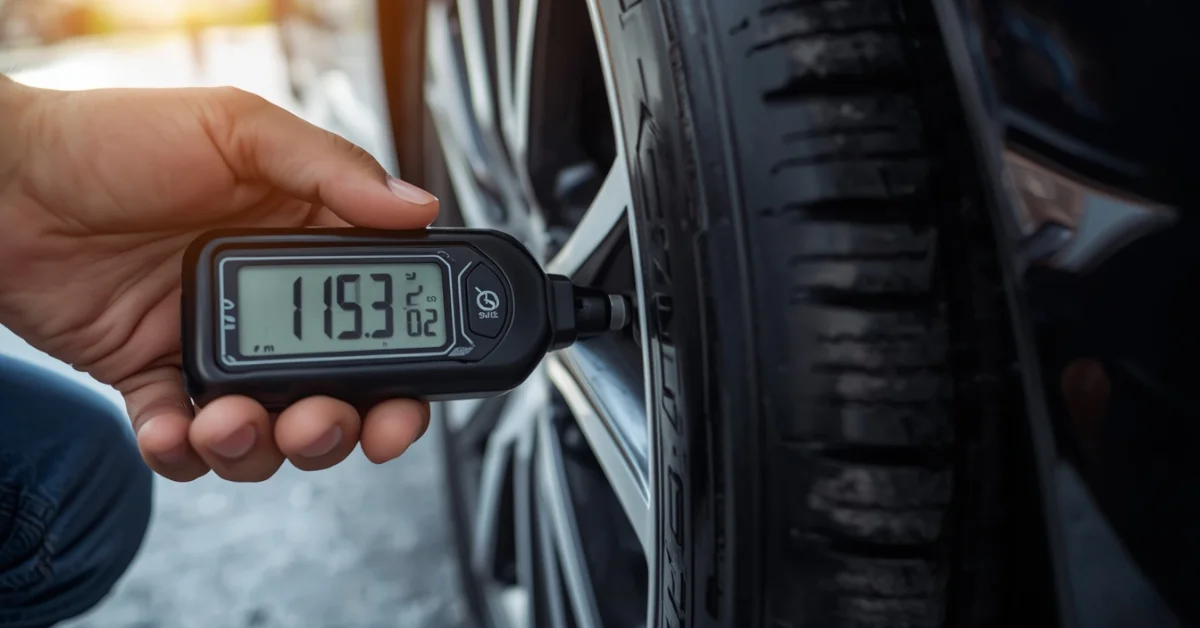
Want to know how to use a tire pressure gauge correctly? Proper tire pressure is one of the most important — and most ignored — aspects of vehicle maintenance in the US. Under-inflated tires reduce fuel economy by up to 3%, cause uneven wear, and increase blowout risk. Over-inflated tires reduce traction and create a harsh ride. This complete guide shows you exactly how to use a tire pressure gauge, covers every type available, and gives you the real PSI numbers for your specific vehicle.
Why Tire Pressure Matters — Real Numbers
According to the National Highway Traffic Safety Administration (NHTSA), tire-related crashes cause over 600 deaths and 19,000 injuries annually in the US. Most are preventable with proper tire maintenance. Here is what incorrect tire pressure actually costs you:
- Under-inflation by 8 PSI: Reduces fuel economy by 3% — costs the average US driver $50–$100/year in extra gas
- Under-inflation by 25%: Triples tire wear rate — shortens tire life from 50,000 miles to under 17,000 miles
- Over-inflation: Reduces contact patch — less traction, longer stopping distances, more vulnerable to road hazards
- Correct pressure: Optimal fuel economy, maximum tire life, best handling and safety
Types of Tire Pressure Gauges
Three types are available at US auto parts stores — each with different advantages:
| Type | Accuracy | Price | Best For |
|---|---|---|---|
| Stick/Pencil Gauge | Good (±2 PSI) | $3–$10 | Glove box backup, occasional use |
| Dial/Analog Gauge | Very Good (±1 PSI) | $10–$30 | Regular home use, most accurate analog |
| Digital Gauge | Excellent (±0.5 PSI) | $10–$40 | Best overall accuracy, easiest to read |
Best Tire Pressure Gauges Available in the US:
- AstroAI Digital Tire Pressure Gauge ($10.99 on Amazon) — Best budget digital gauge, highly rated by US drivers
- Accutire MS-4021B ($12.99 at Walmart, AutoZone) — Most popular digital gauge in the US
- Milton Single Chuck Dial Gauge ($15–$20 at Home Depot) — Best analog dial gauge
- JACO ElitePro ($24.99 on Amazon) — Premium digital gauge, professional grade
Step 1: Find Your Vehicle’s Recommended Tire Pressure
This is the most important step — and most people skip it. Your vehicle has a specific recommended PSI that is NOT the same as the maximum PSI printed on your tire sidewall.
Where to find your recommended PSI:
- Driver’s door jamb sticker — Open the driver’s door and look at the door frame. A sticker shows front and rear recommended PSI (most common location)
- Glove compartment door — Some vehicles have the sticker here instead
- Owner’s manual — Tire section lists recommended pressure
- Gas cap door — Some older vehicles have it here
Common US vehicle tire pressure recommendations:
| Vehicle Type | Typical Front PSI | Typical Rear PSI |
|---|---|---|
| Compact car (Honda Civic, Toyota Corolla) | 32–35 PSI | 32–35 PSI |
| Mid-size sedan (Toyota Camry, Honda Accord) | 33–35 PSI | 33–35 PSI |
| Full-size truck (Ford F-150, Chevy Silverado) | 35–40 PSI | 50–65 PSI (loaded) |
| SUV (Ford Explorer, Toyota RAV4) | 33–36 PSI | 33–36 PSI |
| Minivan (Chrysler Pacifica, Toyota Sienna) | 35–36 PSI | 35–36 PSI |
Important: The number on your tire sidewall (e.g., “Max 51 PSI”) is the maximum the tire can hold — NOT the recommended pressure. Always use your vehicle’s door jamb recommendation, not the tire sidewall number.
Step 2: Check Tires When Cold
Always check tire pressure when tires are cold — meaning the vehicle has been parked for at least 3 hours, or driven less than 1 mile at low speed.
Why cold tires matter: Driving heats the air inside your tires. For every 10°F increase in tire temperature, pressure increases by approximately 1 PSI. Checking a hot tire after highway driving can give a reading 4–6 PSI higher than the actual cold pressure — leading you to believe your tires are properly inflated when they are actually low.
Best time to check: First thing in the morning before driving anywhere — tires are always at their coldest and most accurate.
Step 3: How to Use a Digital Tire Pressure Gauge
- Turn on your digital gauge and ensure the battery is charged
- Remove the valve stem cap from the tire — place it somewhere safe (a pocket, not the ground where it can roll away)
- Press the gauge firmly and straight onto the valve stem — you will hear a brief hiss of air as you seat it
- Hold the gauge firmly in place — the digital display will show the PSI reading within 1–2 seconds
- Read the number and compare to your vehicle’s recommended PSI
- Replace the valve stem cap — finger tight is sufficient
- Repeat for all four tires plus your spare
Pro Tip: Write down each tire’s reading before adjusting any of them — this helps you track which tires lose pressure fastest, which can indicate a slow leak.
Step 4: How to Use an Analog (Dial) Tire Pressure Gauge
- Remove the valve stem cap
- Press the gauge chuck firmly onto the valve stem — straight on, not at an angle
- The needle will jump to the current PSI — hold the gauge steady until the needle stabilizes
- Read the PSI from the dial face
- If you hear continuous hissing, reposition the gauge — air is escaping around the seal
- Replace the valve stem cap
Step 5: How to Use a Stick/Pencil Gauge
- Remove the valve stem cap
- Press the open end of the stick gauge firmly onto the valve stem
- A plastic bar will pop out of the opposite end — this is your pressure indicator
- Read the PSI from the markings on the plastic bar
- Replace the valve cap
Note: Stick gauges are less accurate than dial or digital gauges — use them as a quick check, not for precision measurements.
Step 6: Add or Release Air to Reach Correct PSI
Adding Air:
- Most US gas stations have air pumps — typically free or $1–$1.50 for timed use
- Many Costco, Walmart, and Discount Tire locations offer free air
- Home air compressors work well — Ryobi, Makita, and Craftsman make popular US models ($50–$150)
- Add air in short bursts — check pressure after each burst to avoid over-inflating
Releasing Air:
- Use the small pin inside your tire pressure gauge chuck, or a pen cap, to press the center of the valve stem
- Release air in short bursts and check frequently
How Seasons Affect Tire Pressure in the US
Tire pressure changes with temperature — a fact that catches many US drivers off guard every fall and winter:
- For every 10°F drop in temperature, tires lose approximately 1 PSI
- If your tires were at 35 PSI in summer (80°F) and temperatures drop to 20°F in winter, your tires will be around 29 PSI — significantly under-inflated
- Check tire pressure every month and always when the season changes
- In northern US states (Minnesota, Wisconsin, Michigan, New York), this seasonal check is especially critical
Understanding Your TPMS Warning Light
All US vehicles made after 2008 are required by law to have a Tire Pressure Monitoring System (TPMS). The TPMS warning light — a horseshoe shape with an exclamation point — illuminates when any tire drops 25% below recommended pressure.
Important: The TPMS light is a warning of severely low pressure — not a routine monitoring tool. Do not wait for the light to check your tires. By the time the light comes on, your tire is already significantly under-inflated and you have been losing fuel economy and tire life.
Check pressure manually every month regardless of whether the TPMS light is on.
Frequently Asked Questions
How often should I check my tire pressure?
Check tire pressure once a month and before any long road trip. Most US automotive experts and tire manufacturers recommend monthly checks. In winter, check more frequently — cold temperatures cause pressure to drop quickly. Many drivers check on the first of every month to build the habit.
What PSI should my tires be?
Your vehicle’s recommended PSI is on a sticker inside the driver’s door jamb. Most US passenger cars run between 32–36 PSI. Trucks and SUVs vary more widely — some truck rear tires run 50–65 PSI when loaded. Never use the maximum PSI printed on the tire sidewall as your target — that is the tire’s maximum capacity, not the recommended operating pressure.
Can I check tire pressure at a gas station?
Yes — most US gas stations have air pumps with built-in pressure gauges. However, gas station gauges are often inaccurate due to heavy use and exposure to weather. Bring your own digital gauge for the most accurate readings, then use the gas station pump just to add or release air.
Why does my tire pressure keep dropping?
Normal tires lose 1–2 PSI per month naturally — this is normal. If a tire loses more than 5 PSI per month, you likely have a slow leak from a nail, screw, damaged valve stem, or bead leak where the tire meets the rim. Take the vehicle to any Discount Tire, America’s Tire, or local tire shop — most will inspect and patch the tire for free or $15–$25.
Is nitrogen better than air for tires?
Nitrogen maintains pressure more consistently than regular air — losing pressure about 3–4 times slower. Many US tire shops offer nitrogen filling for $5–$10 per tire. For most everyday drivers, the benefit is small. For those who check pressure monthly, regular air is perfectly adequate. Nitrogen makes more sense for performance vehicles, race cars, and aircraft.
Check Your Tire Pressure Today
Now you know exactly how to use a tire pressure gauge and why it matters. Pick up a digital gauge from Amazon or AutoZone for under $15, check the recommended PSI on your driver’s door jamb, and spend 5 minutes checking all four tires this week. It is one of the simplest, cheapest maintenance tasks you can do — and it directly improves your safety, fuel economy, and tire life every single mile you drive.